



Crossing the Chasm is one of our favorite books at Unusual. As a firm, we are laser-focused on getting companies to product-market fit, but once startups get there, how do they capture a larger segment of the market? In his book, Moore highlights the “enterprise gap” and how startups can bridge the gap between early adopters and the early majority.
You have probably seen this graph before:
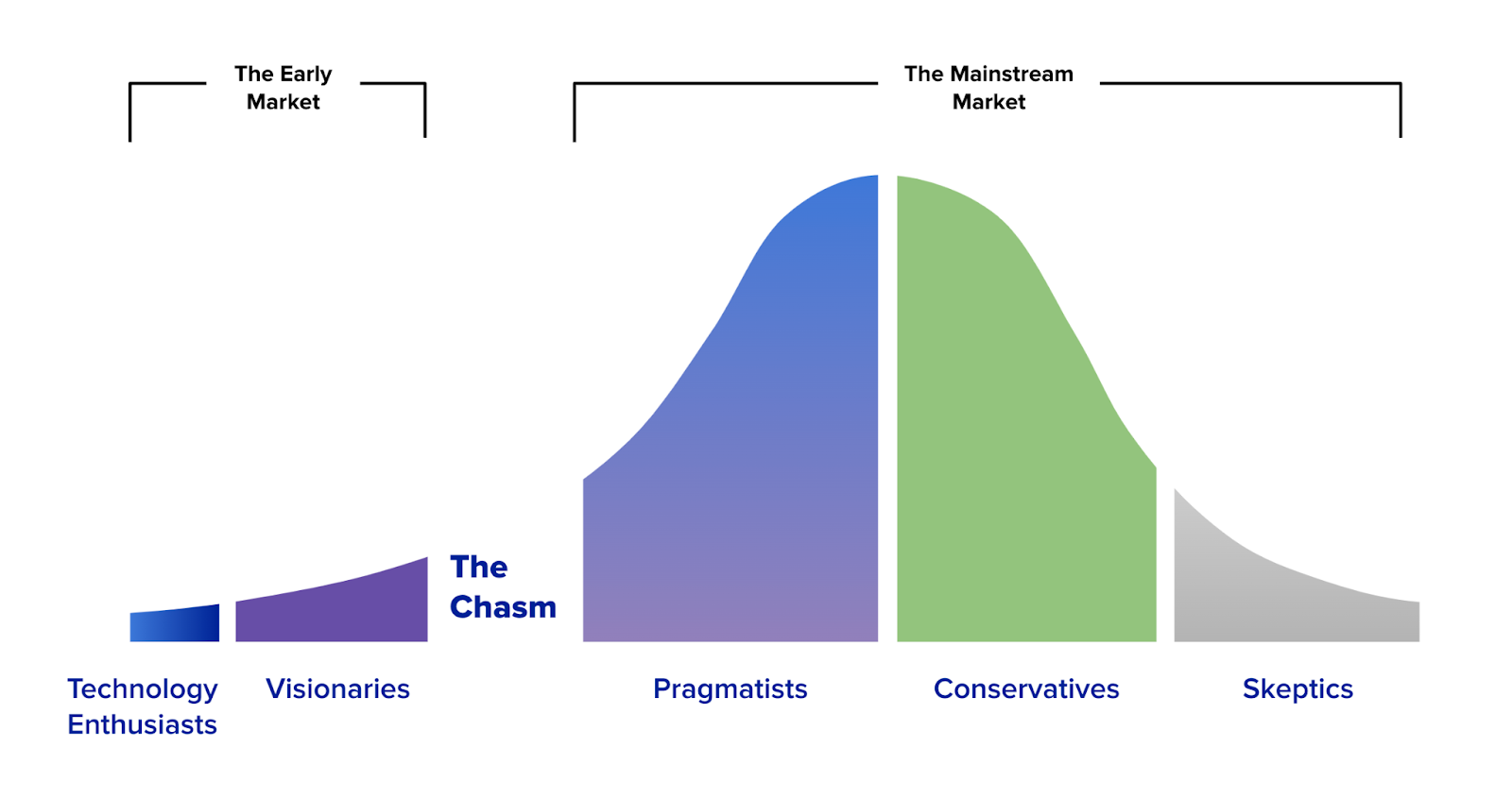
This image represents what Moore calls the Technology Adoption Life Cycle. It outlines how different types of customers embrace innovation:
So how do startups cross the chasm from visionary buyers to pragmatic ones AND build a scalable go-to-market engine?
Pick a market small enough to win but significant enough to matter. Moore recommends a two-stage Market Development Strategy Checklist to assess potential targets:
Stage 1: Evaluate scenarios against four key issues:
If any score is low here, the scenario is out.
Stage 2: Rank the remaining segments against five more factors:
The key is to decide quickly, commit to one market, and go all in. Don’t worry about finding the perfect segment — focus on winning the one you pick.
To win over pragmatists, you must deliver a whole product — a complete solution built around your core offering. Early adopters may assemble the product themselves, but the early majority won’t. Work backward from the target customer’s use case and fill gaps through R&D, partnerships, or acquisitions.
Then comes a surprising move: you must create competition. Pragmatists won’t buy without alternatives to compare — even if you’re the only viable option. Position your product between two established competitors and use a disruptive innovation to address a flaw in traditional offerings, all while focusing on your target segment.
Positioning is not about making products easier to sell — it’s about making them easier to buy. Moore defines positioning as a four-part communications process:
The hardest part is making the claim clear and concise. Here’s where the elevator test comes in:
As you cross the chasm, distribution is your vehicle, and pricing is the fuel. The goal is to secure a channel that pragmatists trust. Moore identifies five customer-oriented channels:
Pricing plays a critical role. It needs to be set to reinforce positioning and motivate the channel. Early on, offer higher margins to distributors, but as the product matures, you can reduce margins, as distributors will compete to carry you.
If you want to read Crossing the Chasm in full, we encourage you to do so! You can check out the website to find out where the book is sold. And make sure you’re subscribed to our newsletter to ensure you don’t miss next month’s book review and plenty of other content from our team.
 All Posts