In this section of the Unusual Field Guide, John Vrionis explains how to structure an effective pitch and navigate the fundraising process.
As an entrepreneur just beginning the startup journey, thinking about all that needs to happen to succeed can be overwhelming.
Many founders joke in a moment of nostalgia, “If I knew how hard starting a company would be, I’m not sure I would have taken the leap!”
Through our time spent with hundreds of entrepreneurs, we’ve noticed that the vast majority break the larger journey into smaller, more manageable phases — each with specific goals.
It may be a management secret, or possibly just a coping mechanism, but either way, chunking works. And conveniently, they’re usually bookended by fundraising events. This is the simple formula:
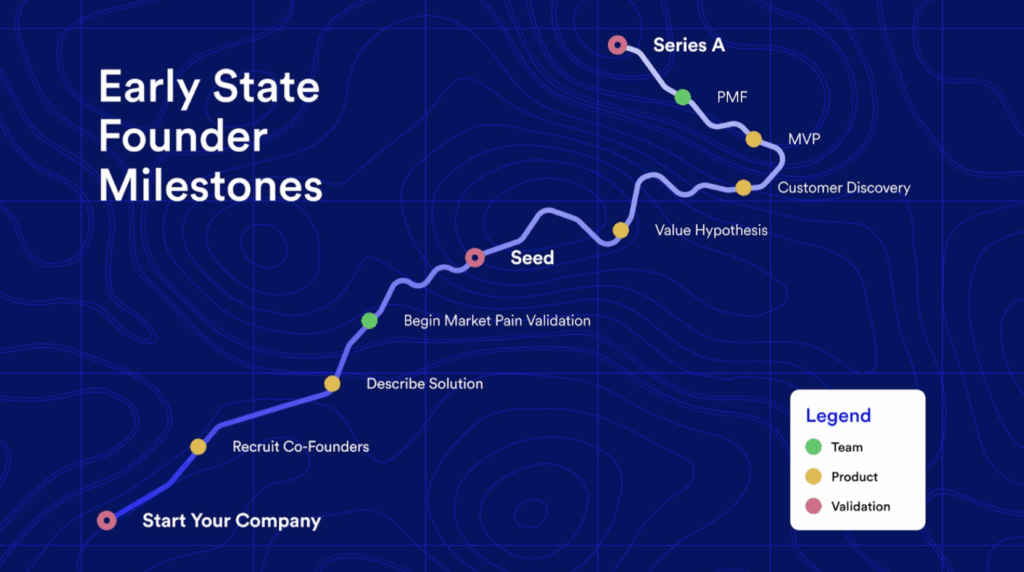
This is the period when a founder is working through the following milestones:
Oftentimes, founders quit their current jobs to focus on accomplishing these milestones before raising Pre-Seed financing, but that’s not always the case.
Many founders raise a Pre-Seed as they transition from their current employment situation to full-time startup mode.
Both can work.
Order of operations is not critical during the Insight Phase! What is most important is getting the right ingredients of a story together that will translate to a very compelling investment.
At this stage, investors primarily focus on the quality of the founders, the depth of their insight, and the potential market opportunity.
A Pre-Seed is raised to make progress on these three dimensions.
Company raises money → Company delivers A, B, & C → Company raises more money →
In the early years of a startup, we believe there are three distinct phases for founders to successfully navigate and an associated financing:
Each phase has distinct goals along three dimensions: team, product, and validation.
The primary goal of the Seed Phase is to find and demonstrate product-market fit.
The milestones to accomplish in the Seed Phase:
We often hear that what investors must see from a company that has successfully navigated the Seed Phase is:
At Unusual, we disagree.
Yes, we want to see customers paying for your solution. However, if these early customers are a diverse assortment of ICPs, this will not yield efficient growth going forward, and the startup will struggle.
Similarly, if early customers were all “friendlies,” the startup will stumble during the early GTM phase: the founders never really figured out which market segment was desperate for their solution or how to build the skillset to acquire new customers efficiently.
A strong early team, a solution that delights early customers (read: real customers), and a tight set of references to build on are the milestones that matter at the Seed Phase. If these milestones are achieved, the company is ready to raise Series A capital.
At this point, the startup is scaling its go-to-market efforts to accelerate revenue based on demonstrated product-market fit.
The milestones to accomplish in the period after raising a Series A:
Startups do NOT increase in value in a linear function, but rather as a step function. The “steps” in a startup’s valuation are tied directly to the company achieving critical milestones and investor perception that the overall likelihood of success for the business is increasing.
A new stock price is assigned at the time of each financing based on the agreed-upon valuation of the company. The valuation of a private startup is imprecise, and significant changes occur only at the time of financing events.
It’s important to note that valuation is inversely correlated with risk. Reduction in risk at each phase is tied directly to the startup accomplishing the necessary milestones for that particular segment of its lifecycle.
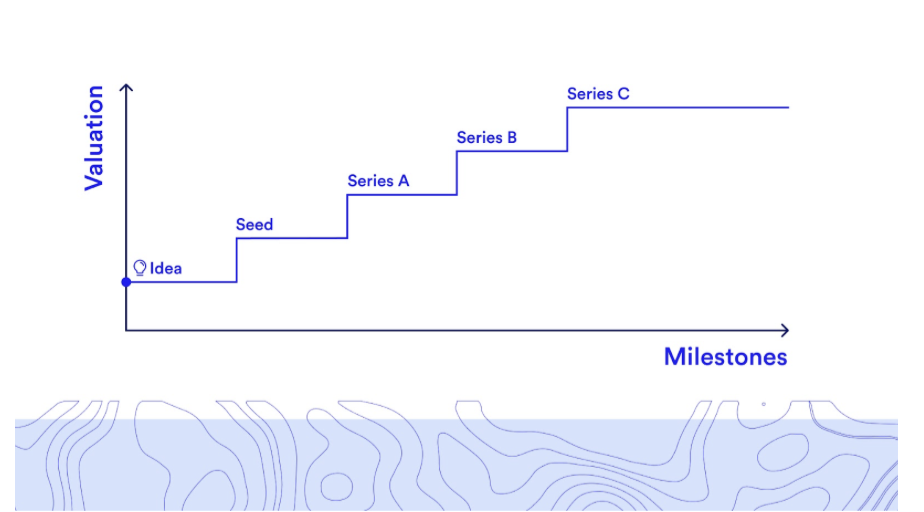
Startup valuations increase as a step function.
They only increase in value once key milestones are achieved. Thinking about it this way enables you to focus on creating a specific set of goals at each stage of your company’s journey, and it’s one of the foundational pillars of the Unusual Way to PMF.
Make note: there is no “partial credit” in the startup journey. Achieve the milestones and de-risk the business such that more capital can be raised — or fail. Or, as we like to say at Unusual:
“Getting 80% of the way to the moon doesn’t count for anything.”
— Team Unusual Ventures
For Pre-Seed, Seed, and Series A enterprise companies, the milestones that need to be achieved at each stage are clear.
Once the right goals have been set, what’s left is the fundraising process itself. This process can be broken down into five basic questions:
 Fundraising