Fundraising is a skill that can be learned and mastered. As a founder or CEO, your number one job is making sure the company has the funding to accomplish its goals.
In this section of the guide, we break down the fundraising process into its subcomponents and provide pro tips for tackling each one.
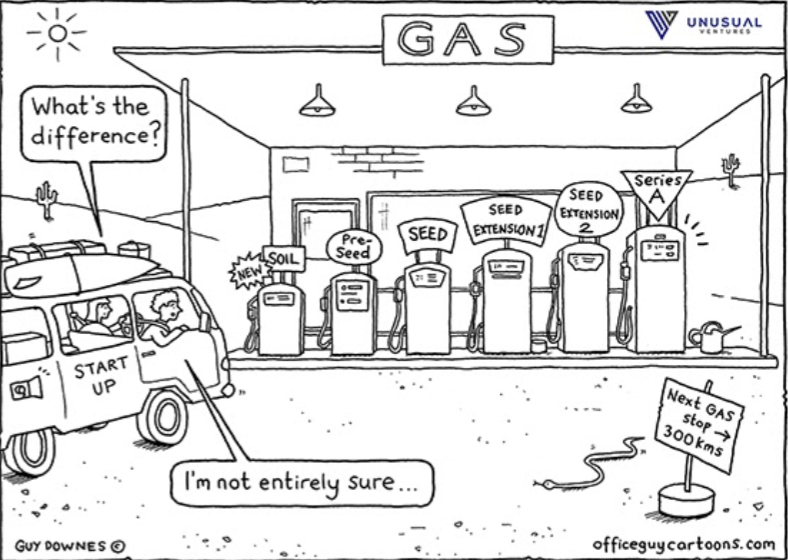
Knowing which investors to talk to and how to label your financing round can be confusing, but don’t let the murkiness slow you down! Dive into Crunchbase and/or Pitchbook and start doing your research. We recommend taking the following steps:
Make special note of those that have had successful outcomes with businesses similar to your own.
Why? Because you want an investment partner who already has deep knowledge of the market space you are going after. This helps them be more helpful as a sounding board, recruiter, and strategic thought partner as you build your company. For simplicity, the broad categories are:
If the financing round labels are confusing, consider three basic stages of maturity to simplify things:
We recommend aiming for an amount that enables the company to execute for 24 months before needing additional capital.
Raising too much capital translates to unnecessary dilution and often, sloppy execution. Optimal innovation tends to come from constraints.
At the same time, raising too little capital puts you at risk of falling short of the threshold goals and valuation inflection, and that’s the worst possible outcome. If you have goals that will take longer than 24 months to achieve, break them down into more manageable increments.
“History teaches us that optimal innovation comes from constraints. At the same time, raising too little capital puts you at risk of falling short of the threshold goals and valuation inflection, and that’s the worst possible outcome.” — John Vrionis, co-founder of Unusual Ventures
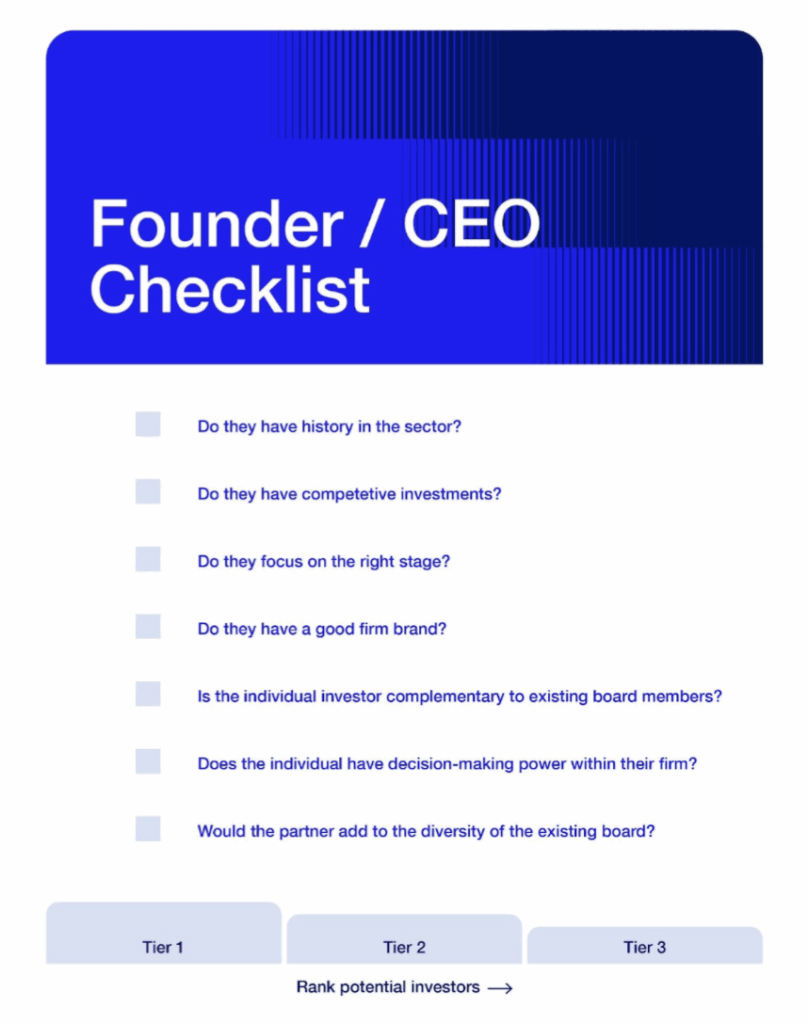
Many investors will invest in competitive companies. But as a founder, that’s something you want to avoid so there are no conflicts of interest.
Narrow down your list to the firms you believe will help you most with attaining your goals in the specific phase you are in.
Break down your list into three tiers: Tier 1, Tier 2, and Tier 3:
If you have questions about which firms and partners belong in which tier, find trusted, experienced people to ask!
Spend the time to do your homework—you owe it to yourself and your team to be informed. That said, recognize that this is not meant to be a precise exercise.
There is no 100% accurate way of doing this, so don’t stress. Now that you have your segmented list, let’s move on to the next step.
Before diving into what will inevitably be a few weeks of mania, it is important to understand three essential facts about the pitch process itself:
You will get better with each investor pitch, so make sure you warm up with two to three meetings with investors from your Tier 2 list. Think of this as testing your pitch “Off Broadway.” Then, schedule four to five Tier 1 meetings within a time-boxed two-week time frame.
Only add new firms if existing ones drop out or don’t engage. We recommend speaking only to investors who are capable of leading the investment, as they will work with you to set critical terms.
Other investors may be interested in participating, but finding the lead investor comes first and deserves 100% of your initial focus.
Reason being, pragmatic, good investors receive a ton of inbound emails and can only invest in a small fraction of the opportunities they receive.
A warm introduction from a strong connection will help grab their attention. It also offers you the added benefit of a feedback channel post-meeting.
Once you’ve secured warm introductions to the investors on your list, the next step is to put together a top-notch pitch deck and tell your story in a way that highlights what the best investors are looking for.
A great pitch isn’t about the slides — it’s about the story and how you tell it.
At the earliest stages, investors are mostly betting on you. The way you explain your vision, your conviction, and the insight behind your company often matters more than the numbers.
When you pitch, investors aren’t just evaluating your market or your deck — they’re assessing your ability to communicate and inspire.
How well you tell your story now is a leading indicator of how well you will recruit early customers, attract top employees, and raise the next round. Great VCs know this. They’re asking themselves: Would I follow this founder into an uncertain future?
Your pitch is that moment. Tell the story clearly, confidently, and with conviction.
In Unusual Academy, we provide every founder with a copy of Jerry Wiseman’s book Presenting to Win because it’s the best, most succinct content we’ve found for guiding fundraising founders.
The key takeaway is that nothing matters as much as your story, and there’s a formula you can follow to guarantee you put your best foot forward. Most of that is appreciating your audience — the investor — and understanding what they will focus on when making their decision.
Pro tip: Your investor presentation is not the same as your customer presentation.
While both presentation decks are intended to sell, the investor presentation must include a compelling narrative about your team, the big opportunity for the company, the economics of the business, and the milestones that will be achieved on this specific financing.
For more on how to put together customer presentations as a Seed stage company, see our Guide for building your first customer presentation.
Of note, the investor presentation should be practically useless without the voice-over. Investors want to work with a founder who has a clear command of the business and strategy.
Consider the slides your props — the main attraction must always be you! Part of the evaluation is showing how well you tell your story!
If the pitch is in person (and we strongly recommend you make the effort to do so), arrive 10 minutes early. Have the IT setup figured out so you don’t waste time fumbling around when the meeting starts.
Use no more than 15 slides and be able to cover the entire presentation in 25 minutes or less, if necessary.
Assume you will get interrupted, but remember that it is your story to tell. It’s okay to confidently respond with, “Great question, I’ll get to that shortly in an upcoming slide. If you don’t mind, hold that thought and remind me if I don’t answer your question.”
Do not send detailed slides in advance of the meeting. That allows investors to turn you down before ever meeting you. (Again: the investor presentation itself should be practically useless without the voice-over.)
Throughout the process, create fear of missing out. Psychologically, humans are motivated more by fear of loss, rather than joy of gain. (See: Kahneman & Tversky, 1979.)
Never share specifics of who else you are talking to. Investors will assume you are engaged with others in parallel. Be clear about the timeline of your process.
Avoid suggesting a price. You only receive an attractive price if you have alternatives (negotiating has little to do with it).
Founders often ask, “How will I know if an investor is interested?” The short answer is: you’ll know. Venture investors turn on the charm when they sense an attractive opportunity.
They ultimately sell money and their assistance for a living — to survive, they have to be very good at pursuing deals.
Another common question from founders: “How should I handle an inbound request from an investor when I’m not currently fundraising?”
Investors prefer to have an early look at an investment opportunity because they are better off if there are no competitors. Talking to investors when you are ready is the best rule of thumb. Just remember that every meeting, whether you like it or not, is an evaluation of some kind.
Investment decisions ultimately come down to greed vs. fear. Startups are, by definition, resource-constrained organizations that will inevitably make all kinds of mistakes.
Venture investors want to bet on visionaries taking on large markets because they know most of their investments won’t work out. Venture capital is a game of hitting a few massive home runs.
 Fundraising