



Like every world-changing technology, AI has raised a slew of concerns ranging from the existential to the practical. As an example, while AI doomers are sounding the alarm on the impending AI apocalypse, business leaders are more concerned about AI leaking sensitive data.
No matter where you fall on the spectrum of AI anxiety, most of us want our AI systems to operate safely and ethically. This is where responsible AI comes in. Responsible AI has been defined in different ways by different organizations (see definitions from Microsoft, Google, and Meta), but at its core focuses on how to mitigate risk and promote security, privacy, and fairness in the development and deployment of AI systems.
Every organization building AI-powered products should be aware of responsible AI. While the largest organizations have dedicated teams, most organizations will need to adopt new practices and tooling to deliver AI products responsibly. In this blog we’ll discuss what responsible AI practices we expect companies to adopt and the opportunities we see for new tooling.
Responsible AI is an umbrella term for all ethical, safety, and governance concerns around AI. While responsible AI incorporates concepts like transparency, explainability, and control, most responsible AI activity is in service of three thematic pillars: security, privacy, and fairness.
AI safety is a concept that comes up frequently in discussions of responsible AI. Safety is generally concerned with ensuring that AI systems behave as intended. There is substantial overlap between safety and security, so we did not call it out as a separate pillar.
Regulations play a role in how organizations will prioritize and adopt responsible AI solutions. AI systems need security and privacy safeguards to ensure compliance with data protection regulations like GDPR and CCPA/CPRA. Systems need to be evaluated for fairness in order to comply with NYC’s AI Bias law, which applies to companies using AI for employment-related decision making, e.g. recruiting or HR. This is also important for compliance with existing anti-discrimination laws as well as proposed legislation targeting algorithmic bias in industries like insurance and banking. The EU AI Act was recently passed by the EU Parliament and more AI-specific regulation is expected to follow.
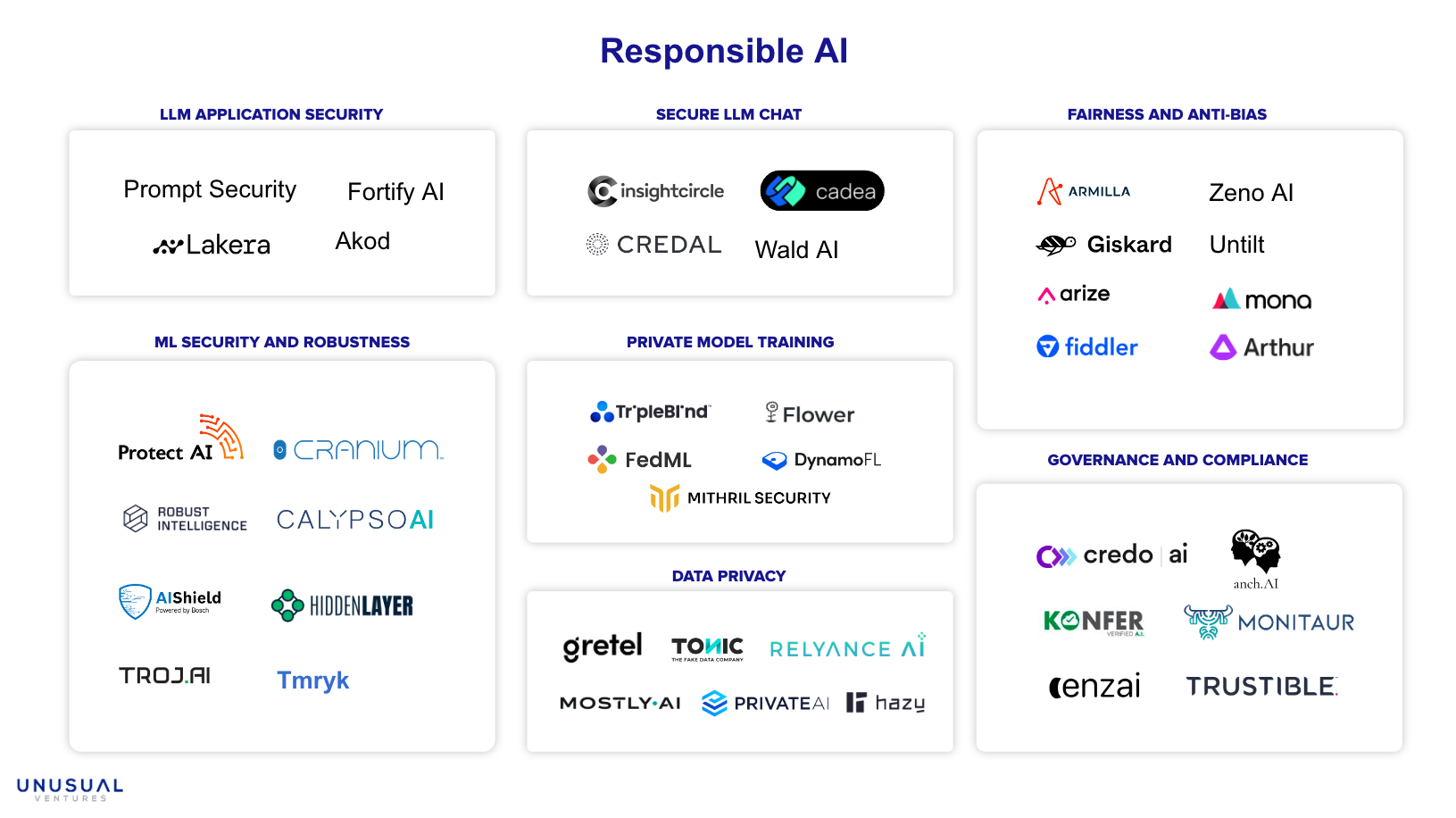
A new landscape of tools is emerging to help organizations develop and deploy AI systems responsibly. On the development side, we’re seeing tools for preparation and handling of training data, and for the evaluation and testing of models pre-deployment. In production, we are seeing tools for monitoring models and detecting non-compliant or anomalous behavior, as well as tools for governance and compliance of AI systems.
Specialized tooling is needed to address core requirements of each of the three pillars: security, privacy, and fairness.
There are security risks across the AI lifecycle, from development to deployment. ProtectAI focuses on helping organizations secure their ML supply chains and protect against threats in open-source ML libraries and ML development tooling. Robust Intelligence, Calypso, Troj.ai, and Tmryk focus on testing and evaluating AI models for robustness against known adversarial threats. HiddenLayer, Cranium, and AIShield focus on monitoring AI infra to detect and respond to adversarial attacks.
The rise of LLMs has led to distinct security concerns that warrant dedicated solutions. For LLM app developers, prompt injection attacks pose AI security and safety concerns. Fortify AI, Prompt Security, Akod, and Lakera focus on solving the specific security challenges of deployed LLM apps. For enterprise users of LLM apps, data protection is a concern that spans both security and privacy. Credal, Insightcircle, Wald AI, PrivateAI, and Cadea focus on enabling secure enterprise adoption of LLM chat.
Most privacy risk starts with the training data. To address this, tools from companies such as Gretel, Tonic, Mostly AI, and Hazy can generate synthetic datasets that preserve the characteristics of the original data. When synthetic data isn’t an option, privacy-preserving machine learning techniques enable training on sensitive data while ensuring privacy and compliance. Mithril security leverages confidential computing environments to train models on sensitive data, while FedML, Flower, and DynamoFL enable training on disparate data sets via federated learning.
Pre-deployment model testing and evaluation is necessary to ensure that AI models are not biased. New startups Untilt and Zeno AI are working on this problem. Continuous monitoring is also needed to monitor production models for bias creep. Arize, Mona, Fiddler, and Arthur are tackling this problem as part of their broader observability solutions.
Existing and emerging regulation means that tools are needed for GRC teams to manage governance and compliance of AI systems. Startups Enz.ai, Monitaur, Credo, Anch.ai, and Konfer are building in this space.
We are excited to meet with folks working on responsible AI within their organizations or building new products. Don’t hesitate to reach out on Linkedin or at allison@unusual.vc. We’d love to hear your perspective.
 All Posts